
Volcanic Islands
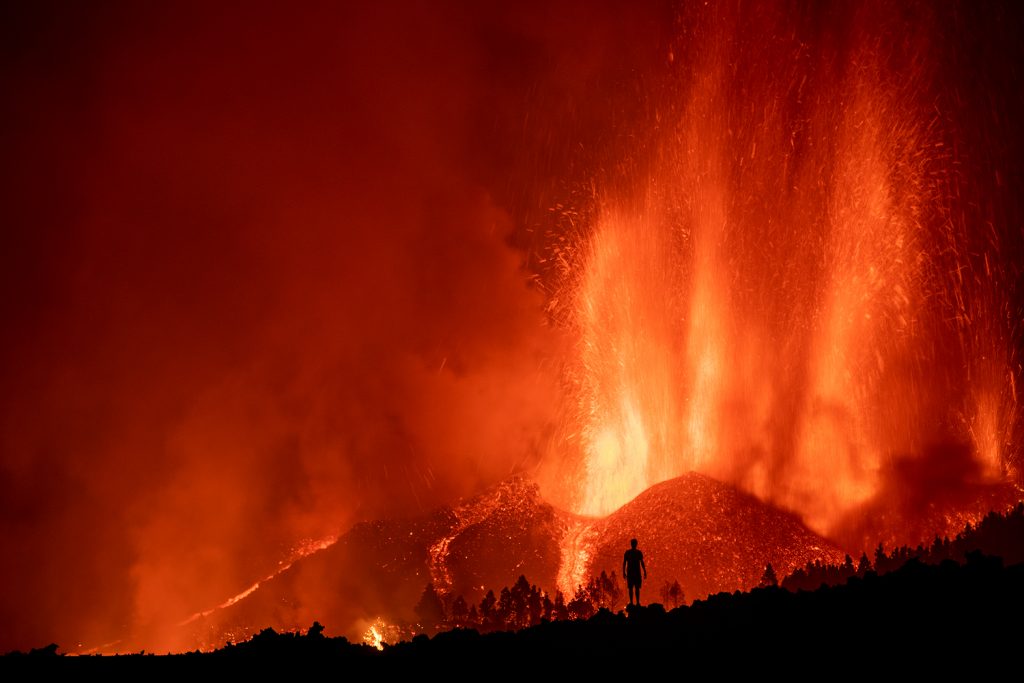
The Canary Islands are a chain of volcanic ocean islands located off North Africa’s west coast (Western Sahara and Morocco). The islands are the type example of oceanic hot spot volcanoes above a slow-moving, thick oceanic plate.
The age of volcanism decreases from east to west, as the Atlantic plate slowly moves above the Canarian Hot Spot. From the oldest to the youngest, the islands are Lanzarote, Fuerteventura, Gran Canaria, Tenerife, La Gomera, La Palma and El Hierro.
Lanzarote and Fuerteventura, the oldest islands, are in their erosional stage and recent volcanic activity is explained by a secondary mantle convection at the continental margin.
Gran Canaria and Tenerife are in the post shield phase with rejuvenated volcanism. Rejuvenated volcanism has not yet started at La Gomera, which is in the erosional stage after the shield building phase has ended, and might skip this stage, as no volcanism has occurred for 2-3 million years and volcanic pathways have probably sealed.
La Palma and El Hierro, the youngest of the island chain, are still above the hot spot and in their shield building phase.(1)
The latest eruption in the Canary Islands, ‘Cumbre Vieja’, has started in the island of La Palma, on September 19th 2021.
The volcano on the ‘Cumbre Vieja’ in La Palma island has erupted this Sunday after days of increasingly strong and frequent seismic swarms. The volcano has already ten eruptive mouths through which it emits incandescent rocks and lava. There is no record of injuries although over 220 buildings are affected by the fire. The Civil Guard plans to evacuate between 6,000 and 10,000 people on La Palma. The authorities ask the neighbors not to approach the area and protect themselves from the ashes.
The lava flows advance, with temperatures of 1.075 degrees centigrade, in the middle of their trajectory, at approximately 0.7 kilometers per hour, according to the Volcanological Institute of the Canary Islands (Involcan), which also indicates that the lava cools and the surface solidifies.
The first volcanic eruption on La Palma, ‘San Juan’, dates back to an unspecified date between 1430 – 1440 and the previous one, ‘Teneguía’ took place from October 26th to November 18th, 1971 and caused one victim by inhalation of gases. (2)
Interested in a brief volcanologist guide to Lanzarote? here is our recommended one: https://www.volcanocafe.org/the-legacy-of-lanzarote/ (4)
(1) https://www.volcanodiscovery.com/canary-islands.html
(2)https://rtvc.es/television/
(3)Image @abiansangil
(4)@volcanocafeorg